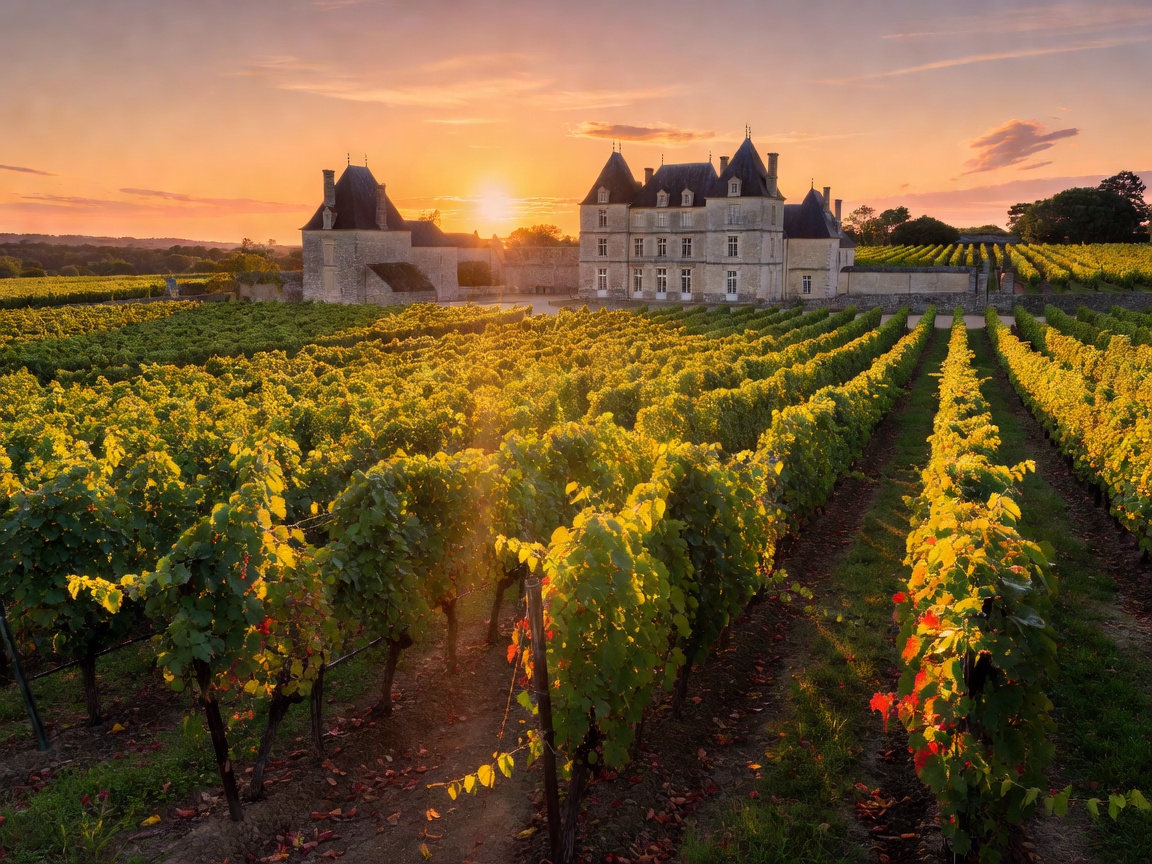
1. The Limestone Catacombs of Saint-Émilion
Beneath the cobblestone streets of the medieval town of Saint-Émilion lies an entirely subterranean labyrinth: more than two hundred kilometers of quarries carved out over nine centuries. When stone was extracted to construct the mansions of Bordeaux, these hollow chambers left behind an ideal, naturally climate-controlled cellar environment maintained at a steady 12°C with 85% humidity.
Here, the Monolithic Church—carved entirely from a single limestone cliff in the 12th century—anchors the village. Outside, Merlot and Cabernet Franc grapes root deeply through the chalk plateau, seeking moisture during dry Atlantic summers.
“Wine in the Gironde is an expression of deep soil layers: gravel washes left by ancient Pyrenean glaciers on the Left Bank, and porous limestone on the Right Bank.”
— Jean-Luc Mercier, Agronomist & Enologist2. Port de la Lune: Neoclassical Bordeaux
Bordeaux earned its nickname Port de la Lune due to the crescent-shaped curve the Garonne River carves through the city center. In the 18th century, royal architects redesigned the riverfront with matching neoclassical facades, culminating in the Place de la Bourse and its modern reflecting pool, the Miroir d'Eau.
Unlike Paris, where granite paved roads dominate, Bordeaux was constructed from golden-tinted regional limestone that glows warmly beneath maritime sunbreaks and misty mornings.
3. Rail Transits: Bordeaux to Arcachon & Sarlat
Regional TER trains link Bordeaux Saint-Jean with extraordinary ecological transitions:
- Arcachon Line: 50 minutes west through maritime pine forests to the Dune of Pilat—Europe's tallest sand dune—and oyster cabins along the Bassin d'Arcachon.
- Dordogne Line: Tracking east following the winding Dordogne River into the cliff-clinging castle hamlets of Beynac-et-Cazenac and Sarlat-la-Canéda.