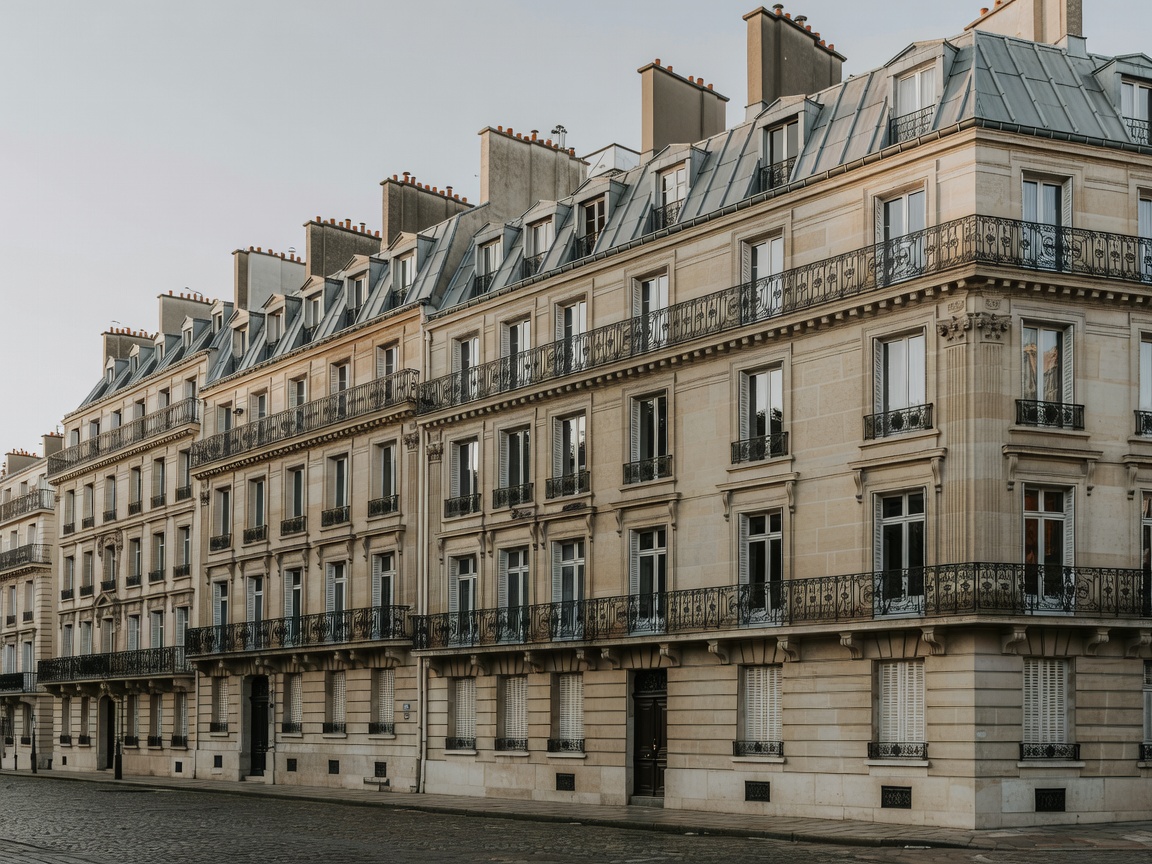
1. The Lutetian Limestone Horizon
The characteristic warm cream hue of Paris is not paint; it is pierre de Saint-Leu and pierre de Saint-Maximin—Lutetian limestone deposited 45 million years ago when Paris was submerged under a warm tropical sea. Baron Haussmann’s prefectural decrees of the 1850s dictated that all street facades must share continuous horizontal lines, wrought-iron balconies on the second and fifth floors, and identical stone dressing.
This strict geometry transformed the French capital into an expansive classical canvas. High above, roofs are clad in blue-grey zinc—a pliable, light material installed by couvreurs-zingueurs whose artisanal trade is currently candidate for UNESCO Intangible Cultural Heritage status.
“Paris is an open book whose pages are turned by strolling on foot. Each courtyard door holds an inner garden or a spiral staircase dating from the reign of Louis XIII.”
— Simone Delacroix, Architectural Historian2. Les Passages Couverts: The 19th Century Precursors
Before grand department stores like Le Bon Marché opened, early 19th-century Paris pioneered glass-canopied pedestrian thoroughfares. These insulated wealthy shoppers from horse-drawn carriages, mud, and rain:
- Galerie Vivienne (2nd Arr.): Built in 1823, featuring classical mosaics designed by master Giandomenico Facchina, antique book dealers, and quiet tea salons.
- Passage des Panoramas (2nd Arr.): The oldest covered arcade in Paris (1799), famed for stamp collectors, vintage postcard merchants, and historic bistro tables.
- Passage Brady (10th Arr.): Known as Little India, vibrant with spice merchants, incense, and hand-woven silk displays beneath vaulted glass.
3. Left Bank Typography & Bouquinistes
Along the stone parapets flanking the Seine between the Pont Royal and the Pont Sully sit over 200 registered bouquinistes. Operating out of dark green iron boxes bolted to the riverside walls, they carry first editions of Balzac, 1920s theatre posters, and architectural diagrams of old Paris.