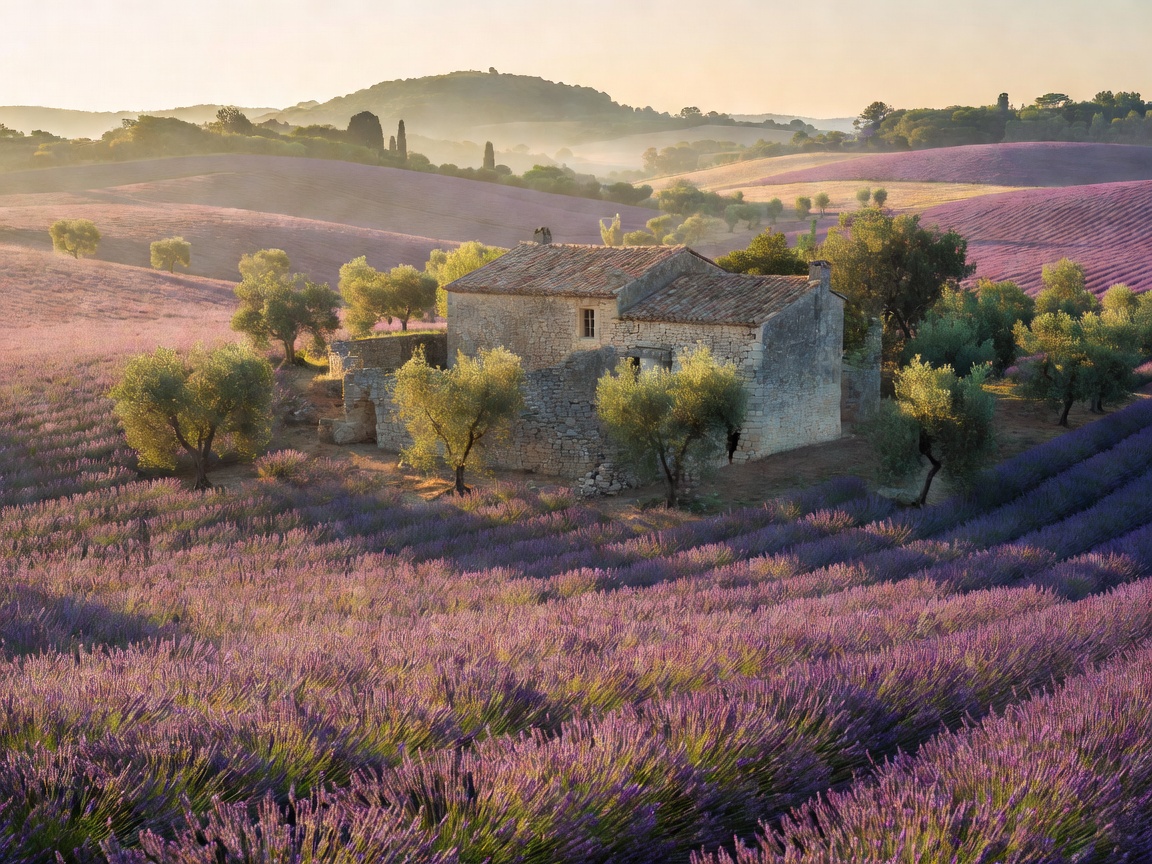
1. The Architecture of Dry Stone: Bories & Villages Perché
In the Luberon mountain chain, geology is not merely scenery; it is shelter. The region is constructed from white Urgonian limestone, mined directly from the surrounding hillsides. Throughout the garrigue, one encounters bories—ancient beehive-shaped shepherd huts assembled entirely without mortar, interlocking through gravitational friction alone.
Perched high above the valley floor to avoid historical raiders and malaria-ridden marsh bottoms, villages like Ménerbes, Bonnieux, and Lacoste appear as organic stone extensions of the cliffs themselves. Lacoste is crowned by the ruined fortress of the Marquis de Sade, while opposite sits Bonnieux, its twin-tiered 12th-century church visible across twenty kilometers of cherry orchards and vines.
“The Mistral wind blows down the Rhône valley at eighty kilometers per hour, stripping moisture from the air and leaving the Provence sky an uncompromising, cobalt cerulean.”
— Henri Flavier, Provençal Architect & Topographer2. Roussillon & The Pigment Mines
A curious geological anomaly breaks the white limestone continuum at Roussillon. Millions of years of maritime deposition combined with iron-oxide weathering left a canyon of deep carmine, saffron, ochre, and vermilion sands. Walking the Sentier des Ocres, you are enveloped in seventeen distinct shades of natural pigment, once exported across the globe to color fine Italian tempera paints and textile dyes.
Early mornings here present an ethereal quiet before the noon heat settles. The local houses reflect this quarry palette: ochre lime-washes protect the exterior walls from relentless UV exposure, framed by sage-green shutters designed to insulate against both summer midday sun and winter frost.
3. Three Coastal Corniches: Nice to Menton
Moving east into the Alpes-Maritimes, the mountains dive directly into the deep blue Mediterranean. Here lie the three legendary roads built at varying altitudes:
- La Basse Corniche (N98): Skirts the sea level through Beaulieu-sur-Mer, Villefranche harbor, and Cap d'Ail.
- La Moyenne Corniche (D6007): Carved along mid-elevation ridges, passing the eagle's nest medieval village of Èze at 427 meters above the Mediterranean waves.
- La Grande Corniche (D2564): The imperial mountain road commissioned by Napoleon Bonaparte along the historic Roman Via Julia Augusta, reaching 500 meters of sheer elevation.
4. Field Tasting Log: Olive Oil, Tapenade & Rosé
The palate of Provence relies on bitter greens, wild fennel, salted anchovies, and the peppery finish of cold-pressed Aglandau olive oil. In Nyons and the Vallée des Baux, olive trees thrive in mineral soils protected from the north wind by the jagged crests of the Alpilles.